The Randomness of Golf

Have you ever wondered why, after seven or eight successful tee shots, the ninth one duck hooks into the woods? It didn’t seem as though you did anything differently. Your set up was the same, your pre-shot routine was the same. So where did that shot come from? Or how about the iron shot. They’ve all been great until out of the blue, you top your 8 iron and it rolls along the fairway bouncing and skipping 50 yards short of where it should have gone. The truth of the matter is that the golf shots you hit are a collection of good shots, poor shots and average shots. You do your absolute best to make them all great shots, but statistics will show you that try as you might, they’re not all going to be great, they will be a mix of shots.  It doesn’t matter if you are a golf professional or a beginner, that’s the mix. The rough breakdown of those shots are 50% average, 25%  poor and yes, you guessed it, 25% of your shots will be GRRRRRRRREAT!  The kicker is, you don’t know when or where the poor shot will arrive or for that matter, the great shot. You just know that it will.  That’s what happened to Jim Furyk off the tee the day he snap hooked a ball into the woods. He seemed to do everything right, but then the randomness of golf happened.  He had a poor shot at a very bad time in the round. Don’t you think he would have rather had the poor shot earlier in the round? Sure, but random is random and that’s what makes golf so interesting. Did he lose the event because of one shot? You might think so, but I would bet that if you went over each and every shot of his final round, you would have found putts that were very long which he made (great shot) and chips that snuggled right up to the hole for his tap in putt.. (another great shot). Had any of THOSE shots been just average, he may have missed the long putt by 2 feet or chipped to 4 feet and missed the short come back putt. Had any of those scenarios materialized, and the snap hook drive (poor shot) was just an average drive, his outcome would have been exactly the same. In the end, he did his best to play his best.

So if you are doing your best and you too have your mix of average, poor and great shots, you have to consider that there is a randomness as to when they will appear. You may make a 30 foot putt on the hardest hole on the course, and then miss a simple 2 foot putt later on during the round. It all works out in the end to whatever it will be. However, we often go over each and every hole, and focus on the single 8 footer missed for par on the last hole, or the single tee shot on the 17th hole that went way right and into the deep rough. It’s decided then that those were the shots that prevented the best score of the season or the league win. Maybe so, but I can assure you, it is simple a case of “selective memory” for certain shots and the “forgetfulness” of others. How about the 30 foot putt back on the 8th hole that fell in after spinning around the rim of the cup then sitting on the edge for a second before dropping in the hole? Or the tee shot that hit the tree and by some miracle, bounced back into the center of the fairway? Golfers don’t always consider the positive effect those shots have on the score. The most common reflection on the round is to see the shots that “should have” or “could have” gone in.

I believe that golfers need to re-frame how they think about their shots and their scores. If we all considered the fact that randomness exists while we play and that all of the shots made are a collection of average, poor and great shots, then it wouldn’t seem like utter failure when there is a triple bogie on a hole. It just means that some of the poor shots happen to group together on that particular hole. The golf swing has not disappeared, nor is the round going to be terrible. It is just going to be. After all, “random is as random does.” If you do your best to play your best, then good shots will follow, I can assure you. You just don’t know when they are going to show up!

Posted in Articles | Tagged , , , , , , , , , , , | Leave a comment

Makin a Bee Line for the Club House

As I arrived at the ninth green during a playing lesson, I glanced up in the tree near the cart path and buzzing overhead were the occupants of this amazing hive. I had to stop and get a picture…THEN I made a bee line for the clubhouse. It really was something to BEEhold!

Posted in Articles | Tagged , , | 2 Comments

Was It A Meltdown at The Open?

I must say, I’ve watched many golf events both live and on TV and this was one of the most exciting tournaments I’ve ever seen.  Everyone thought Adam Scott had it in the bag.  He was due. He has one of the best swings in golf so it seems as though he should be taking home trophy after trophy. He had the lead going into the final round. All he had to do was stay the course. He spoke of being calm all week. He didn’t seem to be extremely nervous. There was nothing crazy happening. He didn’t hit ball after ball out-of-bounds. He didn’t find himself in, what could have been,  a hundred bunkers on the final day. He was just going about his ordinary play hitting fairway after fairway off the tee.  Then, the final four holes arrived and all he had to do was par two of them.  Then there was the roar on 18 when Ernie sunk a 12 foot putt for birdie. Who knows if hearing the roar lead to a bit of self-inflicted pressure as he hit his tee shot on 18 into a bunker. We all saw the rest, pitch out sideways, up on the green and a 10 footer to head into a playoff.  It didn’t happen…but Adam will return, I’m sure of it. And Ernie deserved the win. He played great.

So what was it that did Adam Scott in? A lack of concentration? A mental meltdown? A combination of the two?  Well, it took two people to force the “re-do” on the name carving of the Claret Jug. Ernie played great coming in to shoot a 68 and Adam, maybe a little unfamiliar with that kind of final round pressure in a major, carded a 75.  So how do you pinpoint what happened and how can we learn from this?

We all have parts of our game we would consider our strengths and we are very likely to go so far as to call them our  “favorite” parts of the game. For some, it’s the tee shot or perhaps short irons into the green. Others might consider putting their favorite part of the game. And how we love to practice the things we do well. It’s fun to hit driver after driver on the range…we LOVE our driver. It’s our FAVORITE club in the bag. And those who putt really well? Where do you find them? On the putting green of course…how they LOVE to putt. They could practice that and nothing else.  Ah, but where there is strength, there is also weakness. It is very Yin and Yang and yes, very ancient Chinese proverb like, but very true.  The weakest link always breaks under pressure. It does for all of us. And we all know what part of the game is our weakest, or at least we have a pretty good idea.

So for Adam Scott, perhaps his “weakest link”  was being unfamiliar with a final round lead in a major championship which manifested in his missing critical putts throughout his round. Putting could also be a weak part of his game, therefore it cracked under the pressure. If you know what your least favorite, aka: your weakest link is, then go out and work on it, find someone to help you work on it and turn it into a strength. Practice the things you struggle with and you will struggle less. You will find that you play with more confidence and less fear. So spend some time in the sand or on the green or wherever those “least favorite” shots exist for you. It will undoubtedly improve your score but more importantly, bring more confidence to your stride and a greater enjoyment of the game.

Posted in Articles | Tagged , , , , , , , , , , | 1 Comment

Everything Happens For a Reason

A Note From The Tee,

I am a firm believer in everything happens for a reason. In 2009 I got a call from Kevin McGovern about taking a golf lesson. I recognized the name as I’d seen pamphlets in the Ferncroft Country Club gym with information about his physical therapy practice. He was primarily self-taught, but his handicap was climbing and had gone from a 5 to a 7.
We met for the lesson and very quickly I realized that we were going to work well together.  Just a couple of suggestions and he was hitting the ball better. As I related some of his swing issues to his range of motion and compensations that were taking place, we both had an “aha” moment. Not only was he surprised at my knowledge of the human body and functional movement but  how it impacted the success of the lesson. I mentioned to him that years before, I had worked in conjunction with a physical therapist at the New England Baptist Hospital. We created a program to get patients back to golf safely after orthopedic surgeries. With that, the wheels started turning. We should do something together!

Flash Forward to Now…

I am excited to say that Kevin and I will be working together over the next few months to create a program for the fall/winter.  We will also be exchanging ideas and sharing educational material to all of our client base to help you play better golf and stay healthy.  If you’ve never visited his site, I encourage you to  click here and take a peak. And feel free to join his mailing list. His newsletters are full of great information about staying healthy and feeling better. I’m looking forward to working with Kevin to create great programs for golfers of all ability levels. We’ll be moving and grooving better than ever and in the process, take a few shots off the handicap! Oh, and I’m sure he’d want you to know that his handicap is back to a 5 and trending down…Go Kevin!

Best,
Cathy MacPherson, LPGA

Posted in Articles | Leave a comment

What is Your Bell Curve For Golf?

What is YOUR Bell Curve For Golf?


I thought I would build on, or rather continue the theme of the 80/20 rule from last week and talk about numbers as they relate to scoring. Therefore, I will pose a question. If you think about your handicap, what then, would you consider a good score? What should you expect to shoot each time you go out to play, on average? As you consider what this number might be, I thought I would touch upon the idea of the Bell Curve and how it relates to golf. First however, we need a flashback.

We all remember the Curve from school, don’t we? Mrs. Abbott would get up in front of the class and declare that the test we were about to take would be graded on a Bell Curve…so get your pencils out, sit up straight and when I say begin, you may turn your papers over…. Ahh, the memories of days gone by and the joys of test taking. In the end, there’s an average score, with the majority of test takers falling into that category. Of course there are the highs and the lows, and all the scores find their way on a graph. The bulk of us find ourselves smack dab in the middle. If we had only opened the book to study…AT ALL! But I digress…….

Now, back to golf. And the story begins……you head out on a Saturday to play with your friends. Your handicap is a 13, you feel great and you’re hitting the ball like nobody’s business. You make a rough calculation that you’ll probably shoot anywhere from 80 – 85 today and off you go! The round unfolds and things are not going quite as you had anticipated. A couple of doubles and a triple and your number is climbing! That’s ok you tell yourself, you have 6 holes left to play.  “If I just par 4 of the last 6 holes and birdie the other two, I’ll be ok.” No problem! Well, the numbers you end up writing down on the card, are nowhere near the estimated calculation you’ve made to save the day. Your finishing score? 91. You are beside yourself. “What?! A 91?..how did this happen?”

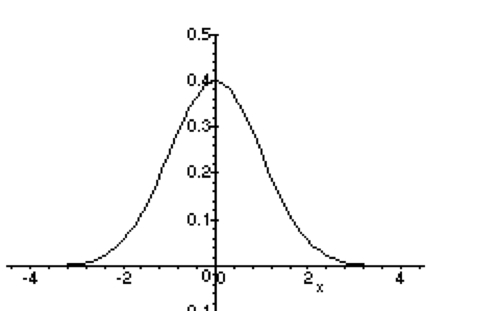
Actually, the 91 is right within in your range of scoring. The problem is, it’s on the higher end of your “bell curve” of scores and you only want to see the lower end. Here’s the dilemma….non of us want to believe we will have any more high scores, especially after our most recent handicap update! Now some of our scores are low (we love those), some are high (not our favorite) and the rest are about average. In statistics, the bell curve represents normal distribution. The shape of the curve indicates that the majority of scores will concentrate in the center with a decrease on either side. If we take all of our scores and plot them on a graph, we’re likely to see the beautiful bell. The 91 is in there along with the awesome 80 we shot last week. They’re all part of the mix and the truth of the matter is, we can’t control or even predict when or which score will find its way to the score card! In fact, statistics prove that we will play average or better only 50% of the time.

So what can we come to expect? What we can always count on is that we WILL have a final score at the end of the round and it WILL be within our estimated scoring range. The more we understand and accept our Bell Curve and all the scores that lie within it, the more we take the pressure off our need to “post a low number”. Embrace YOUR Bell Curve and you’ll enjoy the game more than you ever thought you could. Power to the Bell!!

Posted in Fun and Interesting | Tagged , , , , , , , , , | 1 Comment

Do You Use the 80/20 Rule?

What inspired this particular post was the U.S. Women’s Open final round. Na Yeon Choi had a triple bogie on the 10th hole. She hit her tee shot left into a hazard. After many minutes of discussion, viewing as many TV camera angles as possible, it was determined that her only option for her next shot, given the point of entry into the hazard, was to go back to the tee and re-load. She didn’t rant and rave, she just hopped on the cart for the ride back to the tee. She placed her ball on the wooden peg, did her usual pre-shot routine, selected her target and made her swing. Her confidence for her tee shot was not shaken, she knew that more than 80 percent of the time, she hits a pretty good ball off the tee and in the general direction of her target. In fact, she played like that her entire round. She knew when she had to make decisions based on percentages. Her very own percentages. She knows her 80/20. Do you?

Here’s the scenario. Your ball has drifted to the right and has come to rest in an adjacent fairway. There are no out-of-bounds stakes, you’re not in a hazard, but the line you have that’s directly to the green has a beautiful meadow of fescue in it. You estimate that it’s about 135 yards away. It looks like it’s about 20 yards wide. Oh, and there’s some rough between the fescue and the front of the green. Your final “guess-timation” to the green is about 160 yards… plus a little elevation…so the total comes to about 170 to the middle of the green and the pin is in the back.
A shot like this is all carry. The ball has to be in the air for at least 165 yards. The question is…do you have that shot in your bag? Not just on occasion, but on a regular basis. Here’s where the 80/20 rule comes into play. If you can make that shot 80 percent of the time, then give it a go. If your success rate is lower than 80%….choose another shot. Take a look around and see if you can play a shot to the side to avoid the trouble in front. You want to put yourself in a position that gives you the best opportunity to be successful. In order to score better on the course, you want to consider the 80/20 rule as you play. If the shot you have to make falls into the 80 percent bracket, you’re good to go, if not, consider other options.
When you play to your strengths your score will certainly be lower. You’ll have more confidence when you play and you will be more in control of your game than ever before. So if you are faced with a challenging shot, one that you’ve made only one other time before, and you are thinking about “going for it”, consider the 80/20 rule and make a good decision. You will be happy that you did!

Posted in Articles | Tagged , , , , , , , , , | Leave a comment

Casual Round vs Competitive Round…Why So Different?

Having played many competitive rounds of golf in my career, I always marveled at how the pressure always mounted the closer I got to the first tee on the first day of the tournament. Of course days before the tournament, I played practice rounds with ease. My score was great, shots were well planned and executed and putts rolled in as though they had eyes. Then, the day of the event, eating was not coming easily, the swings on the range were a little less than perfect (they certainly seemed perfect the day before) and the putts were looking at the hole as they rolled by, rather than staring it down and falling To the bottom of the cup. My, what a difference a day makes! Well, it’s less about a different day and more about the pressure, real or otherwise, that changes our environment. Oh, and by the way, it’s not the golf environment that changes, it’s our internal “mental” environment that changes. And the interesting thing is that we do it to ourselves. Have you ever noticed that when you play a casual round of golf, all is great, you play like a champ and score better than ever before. Then, you sign up for your local event or you head out for your league play and the score shoots up and the ball goes all over the course. You wonder what happened to the great golfer from the week before. The environment of casual play is very different from tournament or league play. So, how do you get better in a competitive environment? The key to successful competitive play is to make your casual round a bit more like the one in competition. Create some pressure for score by adding a game or two for the round.  You want to create an environment that brings about similar situations found in competition..the three foot putt to save par, the pitch shot to get the ball back in play, the tee shot that positions the ball for a great approach shot into the green. Doing this will bring your focus to a more elevated level for each shot and at the same time simulate competition. Become more familiar with the tournament or league environment and you will be more successful when it’s time to turn it on!

Posted in Articles | Leave a comment

Storm Rolling In

Storm Rolling In

Late afternoon golf in New England can offer some spectacular sights. Here is the threatening thunderstorm that ultimately skirted east. The color contrast is quite beautiful.

Posted in Articles | Tagged , , | Leave a comment

Nothing Happens Overnight

Congratulations to Brittany Lang who won her first LPGA Tour event last week at the Manulife Financial LPGA Classic in Ontario Canada. She did it in a nail biter of  a playoff that lasted  3 holes. It was the first time she had ever been in a Tour playoff and what a playoff it was! She birdied all three holes to take home the trophy. Another take home gift is a Rolex watch, given to “first time” winners on tour.  I guess one could say, without seeming to pun on the watch theme, “it’s about time” Brittany won on tour….or is it? How long should it take a tour player to acclimate to the rigors of the tour, the endless travel, the grinding competition etc. and get into a rhythm long enough to put 4 good rounds together? If you’re playing tournaments, working with a coach and practicing, how long should it take  before the first win? Any thoughts? If a talented tour player doesn’t win in the first year or two or even three, should they just toss the idea of playing golf for a living right out the window? Should they feel like they can’t play worth a darn, a hill of beans or even worse, that they should  never have taken up the game in the first place? Imagine a tour player, with no wins after three years, declaring themselves a complete and utter failure, stomping on the ground a while, tossing a club or two in the woods or perhaps and maybe even better, cannonballing the whole golf bag right into the water hazard car keys and all! Of course, the tantrum described above is fictitious and no one is tossing clubs, feeling worthless or declaring themselves failures, certainly not tour players. And most definitely not Brittany who took SEVEN years to win on tour. Here’s what she had to say about her first win.

“I can’t believe it took me seven years to win a tournament out here,” Lang said. “I hadn’t been that good under pressure and I’m getting better, and I’m so thankful that it happened this week and I’ll only get stronger from here.”

Pretty positive response don’t you think? She’s getting better, being thankful for the win and claiming that she’s only getting stronger! Now that’s a positive attitude. She sees this win as the springboard for more good things to come! I love that. It’s only about getting better for her, it’s what she has been working towards and she’s thankful that she did it.

Now for the interesting contrast. I often hear phrases such as,  I Got Lucky, That Was A Fluke, I Always Hit It In The Water, I Have No Idea How I Did That, Let’s See If I Can Do It Twice In a Row, when someone hits a good shot, makes a good score on a hole, rolls in a long putt or has a low round. After all,  we’ve all heard the saying, “even a blind squirrel finds a nut once in a while.”  Well, if you are playing golf, taking lessons and practicing, you ARE working towards a good score, a great shot, a fabulous putt and a low round. And when it does happen, and it will,  it is no accident. It’s not even divine intervention or blind luck. It is exactly what you wanted to have happen. So when that ball goes exactly where you intended, embrace it, give yourself a little mini fist pump and make the declaration, “I planned that shot! Yahoo for Me!” When you’re done with the celebratory dance, even if it’s in your mind, build on the success of the great shot you just made. After all, you do want to have more of them, don’t you? I imagine Brittany wants more wins now that she’s had her first. I can’t imagine she’s a one and done kind of player and besides she is only getting better and stronger according to her.  Heck, it’s only been seven years, she’s just getting started and to that I say, “one in a row is a start!” So, Go Brittany, you’re on a roll now, go get yourself number two!

Posted in Articles | Tagged , , , , , , , | 1 Comment

Ferncroft Country Club leads the Way with Zero Food Waste Initiative!

I’m very proud to be associated with a club that is environmentally aware. Bokashi, is a very cool composting method that is quick and easy, providing our chef with fantastic nutrient rich organic matter he easily adds to his herb garden!

Posted in Articles | Tagged , , , , , | Leave a comment